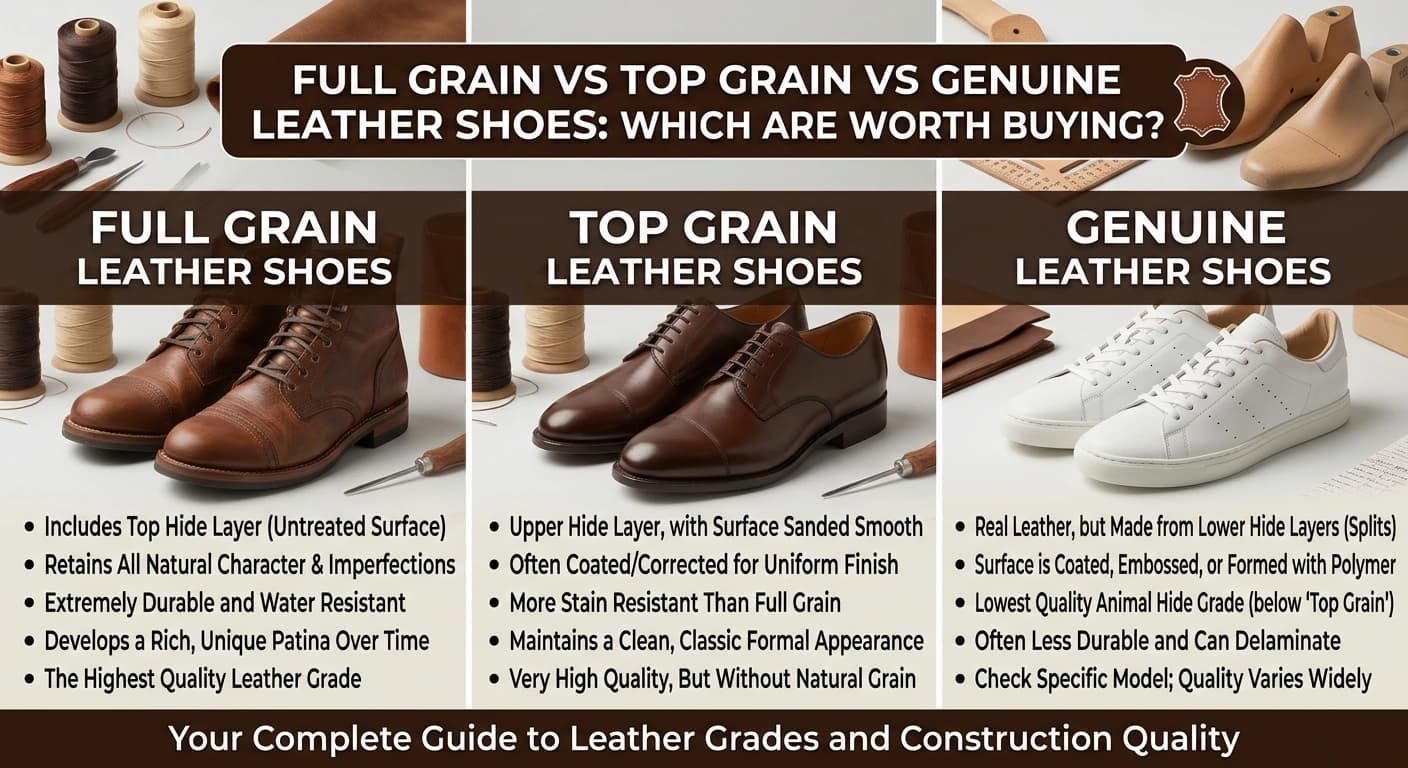
Choosing leather shoes can be confusing when product labels use terms like full grain, top grain, and genuine leather. Although all three terms relate to leather, they do not describe the same quality or finish.
The type of leather can affect how your shoes look, feel, and age over time. However, durability also depends on construction, fit, materials, and how well you care for your shoes.
In this guide, we will compare full grain vs top grain vs genuine leather, explain how to identify real leather shoes and help you choose the right option for your budget and lifestyle.
What Is Full Grain Leather?
Full grain leather comes from the outer layer of an animal hide with its natural grain surface left intact. Unlike leather that has been sanded to remove surface imperfections, full grain retains more of its original texture.
This natural appearance makes it popular for premium leather shoes, boots, and other long-lasting leather products.
Benefits of Full Grain Leather
Durability: Its dense natural grain can make it suitable for regular use when the shoe is well constructed.
Natural appearance: Small variations, pores, and marks give each piece a distinctive look.
Patina: With use and proper care, many full grain leathers develop a richer appearance over time.
Maintenance and repair: Quality full grain shoes can often be cleaned, conditioned, polished, and resoled, depending on their construction.
Things to Consider
Full grain leather generally costs more than many lower-priced leather options. It may also show scratches and natural marks more clearly. Some shoes require a break-in period, although comfort depends on the design, fit, and leather treatment.
Best for: Buyers who want classic leather shoes, quality boots, or footwear that may be maintained and repaired over several years.
What Is Top Grain Leather?
Top grain leather also comes from the upper part of an animal hide. However, its surface is usually sanded, buffed, or otherwise corrected to remove imperfections. It may then receive dyes, protective finishes or coatings.
These treatments can create a smooth and consistent appearance making top grain leather a popular choice for formal shoes and other products where a polished finish matters.
Benefits of Top Grain Leather
Smooth finish: Often has a more uniform appearance than full grain leather.
Versatile styling: Works well for office shoes, dress shoes and smart-casual footwear.
Colour options: Finishing processes allow manufacturers to create consistent colours.
Practical care: Some finished surfaces are easier to wipe clean and may resist certain stains.
Things to Consider
Sanding or correcting the surface changes the leather's natural grain. The breathability, flexibility, and resistance to wear depend on the particular leather and its finish. Top grain leather is not automatically less durable than every full grain product.
Best for: Buyers who prefer a neat, polished look for work, meetings, formal occasions, or everyday office wear.
What Is Genuine Leather?
Genuine leather means the material is real animal-hide leather but the label does not tell you everything about its quality.
Depending on the manufacturer, it may describe different types of leather, including material that has been split, processed, embossed, or coated. Therefore, the words “genuine leather” should not be treated as a guarantee of premium quality.
Benefits of Genuine Leather
Different price options: Some products are more affordable than premium full grain alternatives.
Real leather material: It is not necessarily synthetic simply because the label says genuine leather.
Variety: Available in different finishes, colours, and product styles.
Things to Consider
Quality varies considerably between products. Some genuine leather shoes may wear well, while others may lose their finish, stiffen, or develop surface damage sooner. The material grade, thickness, finish, and shoe construction all matter.
Best for: Buyers who want real leather within a particular budget and are willing to check the product's material details, comfort, and construction before purchasing.
Full Grain vs Top Grain vs Genuine Leather: Key Differences
The following table summarizes the main differences to consider when shopping for leather shoes.
Remember that these are general comparisons, not fixed rules. Two shoes made from the same leather category can perform differently because of their design, finishing, lining, sole, and manufacturing quality.
How to Identify Real Leather Shoes
If you are shopping online or in a store, these checks can help you make a more informed decision.
1. Read the Material Label
Look for specific terms such as full grain leather, top grain leather, or leather upper. Check whether the product description identifies the material as leather, synthetic, or a combination.
A label that says “leather upper” usually refers to the shoe's upper material, not necessarily its lining or sole.
2. Examine the Surface
Natural leather may show small variations in grain, pores, and texture. However, finished leather can look very uniform, and embossed leather can imitate natural grain. Appearance alone cannot reliably confirm the leather grade.
3. Check the Product Description
For online purchases, read the material specifications rather than relying only on the product title or photographs. If the description is unclear, check the manufacturer's material guide or contact customer support.
4. Consider the Smell and Feel
Leather often has a distinctive smell and a flexible feel, but dyes, finishes, adhesives, and storage can change these characteristics. Synthetic materials can also be made to imitate the feel of leather, so this is not a conclusive test.
5. Look at the Shoe Construction
Inspect the stitching, sole attachment, lining, and overall finish. A well-made shoe may be easier to maintain, but stitched soles alone do not guarantee better leather or longer life.
6. Compare Price With Quality
Higher prices do not automatically mean better quality. Compare the stated materials, construction, comfort, return policy, and warranty where available before making a purchase.
Which Leather Is Best for Different Types of Shoes?
The right leather depends on how you plan to wear your shoes.
For Everyday Shoes:Full grain leather is worth considering if you want natural texture and a material that can age attractively. However, comfort, weight, breathability, and sole quality are equally important when you spend long hours walking.
For Office and Formal Shoes:Top grain leather can be a good option if you prefer a clean, polished finish. Choose a comfortable fit and a finish that suits your workplace and the amount of maintenance you are willing to do.
For Boots:Full grain leather is often used for durable boots, but the best choice depends on the boot's purpose. Work boots, hiking boots, and fashion boots have different requirements for protection, flexibility, traction, and water resistance.
For Budget-Friendly Shoes:Genuine leather products may offer a suitable option at a lower price. Check the exact leather description, stitching, sole, and customer reviews rather than assuming all products carrying this label have the same quality.
Leather Shoes and Sneakers Worth Considering
Leather shoes are available in both formal and casual styles. If you prefer sneakers, classic designs can work with jeans, chinos and smart-casual outfits.
The following Adidas styles are worth exploring. However, materials can vary by model, product version and colourway, so confirm the specifications on the exact product page before buying.
Explore Adidas Shoes and Available Deals
Looking for stylish Adidas shoes for everyday wear? Explore the Adidas Australia store to discover available shoes, compare styles and check current offers that may suit your budget.
Stan Smith Shoes
Stan Smith shoes are known for their clean, minimal design. They can pair easily with jeans, chinos, and casual outfits, making them a versatile option for everyday styling.
Material tip: Check the specific version's product details to confirm whether the upper is leather or synthetic.
Superstar Shoes
Adidas Superstar shoes are recognizable for their shell-toe design and classic streetwear look. They can be styled with casual trousers, jeans, and relaxed outfits.
Material tip: Do not assume every Superstar version has the same upper material. Check the individual listing before purchasing.
Samba OG Shoes
Samba OG shoes feature a low-profile design that works well with casual and smart-casual clothing. Their classic styling makes them an option for people who prefer a simple sneaker.
Material tip: Verify the exact colourway's material specifications, as product variations may differ.
Final Thoughts
When comparing full grain vs top grain vs genuine leather, the most important thing is to understand what the label actually tells you.
Full grain leather is worth considering if you value natural texture and the potential for long-term use. Top grain leather can suit buyers who prefer a smooth, polished appearance. Genuine leather can also be a reasonable choice, but its label alone does not confirm its quality or expected lifespan.
Questions & Answers
Frequently Asked Questions
How long do full grain leather shoes last?
There is no fixed lifespan. Quality full grain shoes may last for many years with proper care and repair, but their longevity depends on construction, frequency of use, walking conditions, and maintenance.
Are leather shoes worth the extra cost?
They can be worth it if you value their appearance, comfort, repairability, and potential lifespan. Compare the quality and construction of the actual shoes, as a higher price does not guarantee a better product.
Can genuine leather shoes be good quality?
Yes. Quality varies by the leather used, the finishing process, and the shoe's construction. Do not judge a pair by the term “genuine leather” alone; look at the full product specifications and workmanship.